India’s Evolving Manufacturing Landscape with Piyush Goyal India’s Minister of Commerce and Industry
Center for Strategic & International Studies
Oct 3, 2024
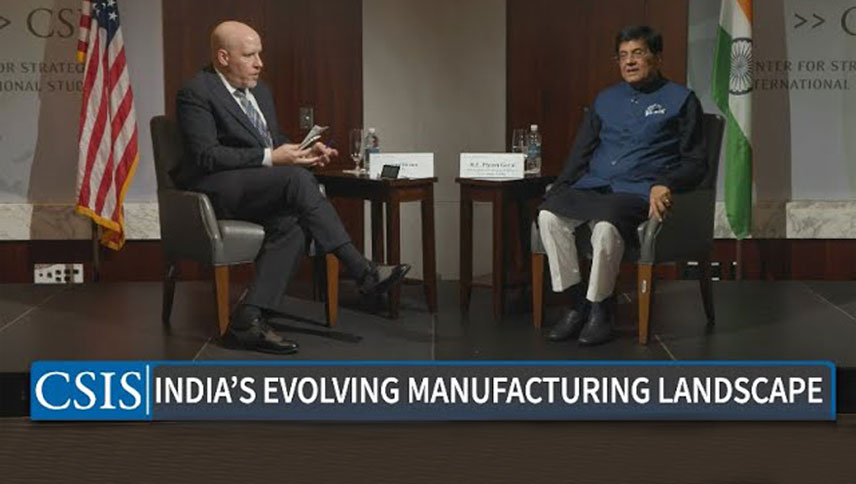
Navin Girishankar: Good afternoon and greetings. My name is Naveen Girishankar. I’m the president of the newly formed Economic Security and Technology Department here at CSIS. I want to welcome all of you for this conversation with His Excellency Minister Piyush Goyal, Minister of Commerce and Industry for the Government of India on India’s evolving manufacturing landscape.
We’re absolutely delighted that the minister has decided to stop by here on his trip. Uh, to the U. S. And would also like to welcome India’s ambassador to the U. S. His Excellency Ambassador Quattro and, uh, Deputy Chief of Mission Ambassador Supriya Ranganathan and several senior officials from the government of India.
Um, the Economic Security and Technology Department are singular mission is to, uh, help the U. S. And its partners, uh, sustain economic and technology advantages that are critical to our long term prosperity. the security of our democracies and our markets and our resilience to shocks like climate change and pandemics.
Um, really what’s important about this, and I want to put accent on this, is our economic alliances with key partners. And that’s why today’s event is absolutely important for us. It’s a signature event. Um, you know, India’s role as a critical partner to the U. S. is something that we are becoming more and more aware of, both with respect to diversifying supply chains, but also more generally integrating our economies with like minded partners, particularly around key technology value chains.
We’ve been watching, uh, the minister’s trip over the last week and really want to congratulate him on his leadership, including the U. S. India CEO forum, uh, yesterday, groundbreaking advancements and agreements that have been signed. Uh, in sectors from defense and energy and pharmaceuticals, uh, and really just highlight, uh, the minister’s dedication to deepening the U.
S. and India commercial investment and trade relationship. Um, our own CSIS chair for U. S. India policy studies, Rick Rosso, my colleague and friend, has carved out a really a novel space, uh, in U. S. India relations, looking not only at national level economic reforms, but importantly, Uh, really a unique, uh, state level agenda that he’s developed over the years, um, and including supporting the U.
S. India, uh, CEO Forum’s Working Group on Manufacturing and Supply Chains. Uh, we’re really proud to have, uh, Rick’s program as a centerpiece for the Economic Security and Technology Department. So today, we’re gonna hear from the Minister, and then Rick will, uh, lead Q& A, uh, which will be really quite interesting.
Um, let me just. Let me just say this for for those who haven’t been paying attention who are watching and I don’t know why you wouldn’t be. Uh, Minister Goyal has served as Minister of Commerce and Industry since May 2019. Uh, really at the center of Indian, uh, industrial efforts, domestic manufacturing, uh, from trade to foreign investment regulations to working with state governments.
He’s been at the center of that. I had the good fortune when I worked with Secretary Raimondo until I I recently joined CSIS, uh, to see Minister Goyal in action at the Indo Pacific Economic Forum negotiations. And this was going back to the Los Angeles ministerial, which was a pivotal moment. And since then, there has been so much that the minister has had his, uh, his fingerprint on, uh, not only IPEF, uh, but you know, the U S India MOU around semiconductors, uh, several other things, which we’ll hear about today.
It’s really a honor, I should say, swagatam, minister, or suswagatam. And with that, I’m going to hand over to Rick.
Richard M. Rossow: Well, actually, I’m just going to hand the floor directly over to the minister. That’s who everybody’s here to see. So please join me in welcoming Minister Goyal to the, to the lectern.
H.E. Piyush Goyal: Richard, Naveen, Ambassador Khatra, Ambassador Ranganathan, distinguished colleagues from CSIS. My colleagues who have come down from India to be a part of the U. S. India’s CEO forum and the commercial dialogue, see a lot of young faces here. So I assume there might be some students here that should make the afternoon even more exciting.
Ladies and gentlemen, today happens to be the first day of Navratri. That’s the Indian festive period of nine days. And they say everything which you begin during this period will do well. It’s an auspicious way to begin things. So I think my reconnection with CSI is after seven or eight years happening on the first day of Navratri is a very ominous or auspicious sign for me.
But thank you for giving me this opportunity to connect with, uh, colleagues, uh, interested in India, particularly on a subject which could at times be a little drab when we are talking of manufacturing and India’s, uh, own evolving manufacturing landscape. But as I was telling Ambassador and colleagues whom I met below, that I’m okay with whatever question they want to ask, even beyond manufacturing, there’s no problem.
You don’t, don’t need to curate too much of the, uh, discussion. So people don’t feel let down having spent an afternoon here. Friends, uh, Gandhiji had started the call for self reliance. in the pre independence days. At that point of time, that was a need of the hour. There was a need of times that India needed to bring back manufacturing into the country for its own needs, for its growing needs, to help the economy grow, to create jobs for the people.
While India did a lot of work in the manufacturing landscape in the initial years. A lot of it was government led. We had the public sector undertakings, investing and manufacturing. Several large plants came up and a few private, uh, plants or private manufacturing units, which were much smaller in scale and dimension did come up at that point of time.
But for at least the first three or four decades after independence. I believe we largely remained a government led manufacturing ecosystem. In some sense, we lost a lot of opportunities. For example, efficiency never really became important because you’re in a government job, cozy, comfortable. Uh, your promotion is going to be time based, not merit based.
Salary is going to come in irrespective of what work you do. And that compromise not only our efficiency, but also our quality. And over a period of time, I think those three or four decades, India remained a very inconsequential player in the world economy in terms of our manufacturing.
Prime Minister Nare Modi came in in 2014 during which, uh, period between 91 to 2014, India had made certain strides in manufacturing. We had given a serious trust to private sector participation in manufacturing, economic liberalization through fits and starts, had started, uh, showing some impact. So 94, we saw some effort to de license industry, promote private sector coming in into manufacturing at scale.
Then again, there was a period of political uncertainty once again, for about 10 years from 98 to 2006 or seven, we saw an effort to. We are in a time when we need to further liberalize the markets, the financial markets, deregulate number of sectors, give a little thrust to manufacturing, generating power in the country.
But again, the post Lehman collapse, the 2008 global financial crisis, India went down a path where we tried to pump prime the economy. Through large fiscal deficits, but really couldn’t manage the entire post, uh, global crisis situation well enough to safeguard India’s interests. And by 2014, India was considered a fragile five economy, one of the weakest five economies in the world.
With very low growth rates. We had come down to about 4.3% of growth. GDP growth rates. Our inflation after having an affair with double digit inflation from 2009 to 12 or 13 was still at elevated levels of eight 9%. Interest rates were exorbitantly high, partly because. There was indiscriminate lending in the government banks, leading to large amounts of money blocked in non performing assets, very often shoved under the carpet by restructuring of loans.
And ultimately somebody had to pay for all of those bad loans. It was the good borrowers. It was the new borrowers who had to pay much. higher rates of interest to pay for these bad loans. Our foreign exchange reserves were almost in a crisis situation. So much so that the then finance minister in September, 2013 had to raise 35 billion at almost twice the then market rate just to shore up reserves and shore up the rupee value.
But such things only are temporary. Also, at that point of time, a series of scandals came out of the closet. One after the other, we saw irregular allotments of coal mines, irregular allotment of telecom spectrum, scandals around corruption in Commonwealth games. In our space mission, in a way, the morale of the country was very weak at that point of time in 2014.
And investors across the world were very hesitant to work with India. There was a concern about stability of policy, about predictability of tax laws. Some of you may remember the retroactive amendment to income tax that initially it’s hurt Vodafone that became the poster boy of bad law. And of course it must have hurt many other companies, K and Energy in different sectors leading to a loss of investor faith and investor interest in India.
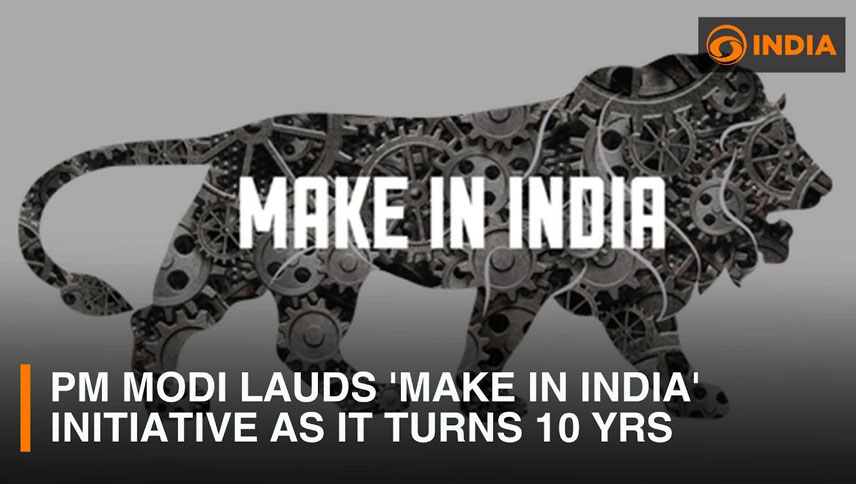
I’m giving you this background not to politicize the situation only to lay the context. In which Macon India program was launched on 25th of September, 2014, and friends, uh, only last week. We celebrated 10 years of the Macon India program and we, we are celebrating it as a week from 25th, September to second October.
And in that sense, we are, uh. It’s very appropriate that we are discussing the manufacturing landscape of India today as a part of our report card to all of you for what we could do in 10 years and what we plan to do going forward. This also reflected or resonated very well with Prime Minister’s vision for Atma Nirbhar Bharat, that’s a self reliant India.
But when we talked about self reliant India, we were not looking at closing India’s doors to international engagement. On the contrary, what Prime Minister Modi was trying to do was develop our skill sets, develop our manufacturing abilities, where we have the comparative advantage of every can be competitive, but also open the doors to international engagement, international engagement.
And I think the United States relationships much wider than ever before attract foreign capital and investment. Increase trade. Two ways import and export. And become a serious player in the international trade across the world, both in goods and in services. It is in that very serious. Difficult time.
that this program was launched. And at the end of 10 years of a series of initiatives around make in India, which over the last 10 years have helped keep the wheels of manufacturing moving or the wheels of our lion. I don’t think we put up the lion anywhere, but a beautiful logo was made for the make in India program, which had This is the first time I’ve seen a lion and the wheels of his feet, almost like the wheels, uh, progressing and, uh, in 10 years, we came out with a series of steps to supplement this initiative to promote make in India to make up for the lost decade before that, we also wanted to get out of the policy paralysis that had struck the nation.
Take strong and, uh, fast decisions, decisions needed to take the economy forward at speed. There was a zero tolerance policy, particularly at the center where Mr. Modi’s government had writ and in many of the states where we were able to influence policy and ensure that investors are not confronted with discriminatory policies.
Or, uh, day to day red tape ism or corruption in their work, and we set around setting the macroeconomic fundamentals of India back into shape. So from 14 to around 18, 19, we had a period where we continuously saw our foreign exchange Without artificial borrowing, a genuine increase through greater degree of interest of investors into the country and other forms of income, whether exports or, uh, remittances or non traditional inflows of forex.
We saw our inflation rates come down and for almost 10 years of the Modi government, our average inflation has been the lowest. That any decade in the past, uh, has witnessed in India never before has an average deposition average inflation of 10 years been as low as about 55 and a quarter percent as we saw from 14 to 24 the saw growth rates wedge their way up to seven, 8%.
We saw interest rates come down along with inflation and necessary and natural correlation. We saw interest rates also right size to attract investments into the country. We introduced the goods and services tax to integrate the national market with a common tax. The insolvency and bankruptcy code introduced for the very first time A bankruptcy court which gave ability to bankers to start liquidating companies and recovering almost 200 billion dollars and largely public sector banks had 200 billion dollars stuck up in either non performing assets or restructured assets, both of which were equally bad and were a drag on the banking system.
Along with that, we made sure that the mood of the international investing community and other governments also became positive for India. Prime Minister Modi spent a lot of time rebuilding relationships across the world, whether it was the U. S. government and right from the word go, we’ve. Had better and better relations with the U.
S. from 14 till now. Other parts of Europe, the Southeast Asian region. In fact, in the first few years, we even made a very serious effort to have very good relations with both Pakistan and China. Both our neighbors with whom, uh, we’ve had relationship problems for years. Mr. Modi gave it a full shot, made every effort even to rebuild bridges and relations with these countries.
And I think these relationship building efforts across the world continue to bear fruit even today. We were confronted with COVID very soon into our second term. Most parts of the world, the developed world had written off India They had felt India would collapse as a nation, the economy would not be able to overcome the crisis that COVID, uh, offered to the world that we could all foresee is coming before all of us, whether the health crisis, the economic crisis, but, uh, that’s been another area where India navigated COVID.
And this is a good time to together. Very well, whether it’s the management of the economy, whether it’s management of the health risk, and it’s the management of our vaccination program through technology and dedicated, uh, health professionals who helped us administer almost 2 billion, 2. 5 billion vaccine doses.
We have seen the progress through the length and breadth of the country. So much so that in some small hamlets, where three or four families would live deep inside a forest. With no connectivity or at the top of a mountain. 15, 000 12, 000 ft tall. We ensured the vaccines going there. Whether it needed people trudging with backpacks.
To go and deliver and, uh, and, uh, provide the vaccine, or even if it needed drones or helicopter services. In every respect, every life mattered. And when it needed a strong lockdown to arrest the spread of COVID, we introduced probably the world’s most severe lockdown. And the people of India trusted Mr.
Modi enough. But when it the economy needed to come back into shape, we brought the economy also very quickly back in shape. For those of you who understand Hindi. If you recall, Prime Minister first said, We must save lives John. If you have life then there’s heaven before you you can have a good life ahead of us if you’re dead Anyway, everything is over.
And once we were able to arrest COVID to some extent, to the extent it was possible, we focused on lives and livelihoods. Jaan bhi aur jahan bhi. We ensured that people got an opportunity to bounce back in their economic activity whilst protecting lives. And I don’t think even the developed world would have had As smooth the transition of the economy as India saw soon after COVID started waning away.
So we, we had a tough year nine, uh, 2021. We had a degrowth year, but were quickly able to bounce back with, uh, 21, 22 making up for what we had lost. And since then the economy continues to grow the last three years. We’ve grown by an average of about 8%, and this current year up to March of 25, we are expecting anywhere between seven to 7.2% growth at the minimum.
I, I am one of those who believes we could do much more, and I do hope we’ll continue to persevere to go for a double digit growth of the Indian economy. Friends during this period to build up the investor confidence to, uh, increase jobs, employment opportunities. On the one hand, the macroeconomic fundamentals were strengthened.
On the other hand, we eased the business processes with nearly 40, 000 plus procedures, processes, government We have decriminalized several laws to make sure that people are not working with the threat of or a gun on their head with jail terms or police action for even minor misdemeanors. Because ease of doing government has been a whole of the government approach, both at the center and with most of the states on board.
Even though Unfortunately, the World Bank had to discontinue ease of doing business because our northern neighbor probably did something which was not entirely kosher. Uh, we continued to have a business reform action plan with our states in support so that India could continue to make it easier for people to do business.
We’ve tried a lot to, uh, make it very comfortable for people to invest or do manufacturing in India, but there’s always scope for more. And we continue in every single opportunity that we get to seek suggestions, to get honest feedback, to get candid, uh, comments so that we can do better in the years to come.
Thank you. I’m very confident that with the series of steps, and I’m not listing out, I have several more that I can discuss with you, whether it’s our innovation landscape, whether it’s our effort to promote design and design from India, serve from India, whether it’s the 20 new industrial smart cities that we are setting up all across the country, or the massive thrust to reduce the logistics costs.
and improve connectivity across the country. A series of steps, both to create new jobs, make manufacturing more competitive and increase our share of global trade has been our effort over the last 10 years, the markets of different sort, international markets for our goods and services, stock market as a parameter of.
Where the world sees us in the future, stock market normally discounts the past and is focused on what’s going to happen in the future. And the fact that the stock market has gone up about four and a half X in the last 10 years. I remember when we came into government, our index was at about 5, 700 or thereabouts.
It’s at about 25, 000 today. It’s a measure of, I think, the success story that India has presented to the world over 10 years. The fact that we are committed to providing a better quality of life to every citizen of India. We are committed to make India a developed nation by 2047, when we celebrate 100 years of independence.
That we are committed to grow from a three and a half, 4 trillion economy today to a 35, 40 trillion economy in the next 25 years. The fact that today India is considered a reliable partner. When we talk of French shoring, when we talk of working amongst trusted partners, India figures high on the list of most parts of the world.
And therefore, I believe that our effort to maintain the manufacturing ecosystem in India, even despite all the challenges we inherited in 14 and the COVID crisis of two years, two and a half years, the two wars that continue to subsist, threatening to escalate with the Red Sea crisis, uh, having affected our international trade.
With all of these challenges, the fact that Indian economy grew by 90 percent when the world economy grew by about 35 percent in the last 10 years. And we have maintained our manufacturing share at 17 percent despite all these challenges inherited and faced in the last 10 years. It gives us the courage of conviction and confidence to believe that we can aspire to take Indian manufacturing to about 25 percent in the next decade or, uh, thereabouts, and truly make India the manufacturing powerhouse of the world, help us take our exports to much more respectable levels.
I have a target of 25%. A trillion dollars of merchandise and a trillion dollars of service exports by the end of this decade. And I’m sure the world will see the unfurling of the India story month on month, quarter on quarter, year on year in the days ahead, continuing to power the world economy, continuing to provide a friend, a trusted partner for those from the democratic world.
Who have now recognized how important the rule of law is for trade and business and India offers to the world a country with a large domestic demand, 1. 4 billion aspirational Indians connected with the rest of the world, aspiring for the good things of life in a democracy, a vibrant democracy where nobody is discriminated against.
And everybody gets an equal chance to grow in life. Thank you very much friends.
And I’m open to any questions.
Navin Girishankar: Well,
Richard M. Rossow: a few things kind of popped out for me. Of course, he not surprisingly answered most of the questions that I had before I was able to, uh, to pose them. But, you know, trust, what an important point that is. And, uh, Let’s talk about what a historic moment we’re in, for the minister to be here right now, and for the prime minister to have been here a week ago, and for the U.
S. National Security Advisor to have been in India recently. So many of these visits happening, I don’t know if your government’s heard, we have an election coming up, you know. When we talk about the bilateral nature of this relationship, there’s no better evidence about how strong the support is for the relationship than the fact that they feel this comfortable engaging at this heavy.
in the, uh, the weeks before, uh, a U. S. national election. So, let’s just pause for a moment, too, and appreciate that. It’s not just rhetoric, you know, it has really become real. And I love the articulation of a lot of these big reforms the government’s done, and sometimes companies know it’s the small reforms the government’s done, too, that make, uh, make a lot of sense.
I, I think back to my days at U. S. India Business Council, and I was working for a company that was trying to invest in India for water heaters. And water heaters at the time were on the reserve small scale industry list. So you couldn’t, you couldn’t invest in manufacturing water heaters. If you had more than a dozen employees or something.
And to see that list done away with too, so sometimes it’s the, the smaller, more nuanced reforms that really do unlock, uh, some of that manufacturing opportunity. Uh, I’ve got a few questions I’m gonna tee up, but I think people had at their seats, uh, cards that were there, so if you want to write down as legibly as you can.
I’ve got a few staff members walking around, and, uh, they can, uh, pick those up in between. But, Minister Goyal, let me kind of pick up on your own serious engagements you’ve had with the United States. We had the Quad meeting, the Prime Minister’s trip, and a lot of that, when we think of the U. S. India commercial lane, you think of the really leading edge high tech stuff.
You know, the semiconductor announcements and things like that. A lot of these sectors that have been on the forefront of U. S. India commercial discussions of late are not always the job creating sectors. Is there a space that you’ve got in some of your dialogues with the United States? Is there ways we can kind of open up that aperture a little bit more?
When you think of textiles and paper mills and basic chemicals, you know, because that’s not been as prominent, I think, in the big dialogues that have happened. Is the CEO forum the place? How do we begin building more manufacturing momentum from the United States in those areas?
H.E. Piyush Goyal: Richard, I suspect you had somebody in on both my meetings today.
With Gina and Catherine. Because, uh, this was high on the agenda in our discussions with both my counterparts in the U. S. Incidentally, since you mentioned about the number of visits, Ambassador just pointed out to me that we’ve had the Defense Minister of India come here, we’ve had the Foreign Minister who left only two days back, the day before yesterday.
I am here now. Next week, my finance minister, Nirmalaji is going to be here. In between, we have the Prime Minister with the National Security Advisor. So, just to give you a flavor of the depth of this relationship, we spoke about election. We’ve worked with three administrations. The Obama administration, the Trump administration, and the Biden administration.
So I think this is a relationship that has stood the test of time. And we’ll continue to flourish and grow because we are natural partners and, uh, two democracies of significance of this nature can impact all of humanity, can have an impact on the world at large. And therefore I’m very confident that, uh, this relationship will continue to only get better and better.
As regards job creating sectors of manufacturing and Other areas, uh, a lot of the world’s manufacturing is going to be influenced by technology going forward. So countries like the U. S. provide an opportunity for us to engage with technology, bring technology to the country, which ultimately will impact all of our job creating sectors.
To give you a case in point, high quality textile machinery. Used to be made in Europe once upon a time. Gradually that has moved to our northern neighbor, China. Maybe it’s more cost effective also. I don’t know about the quality, but certainly in cost, it could be an attractive proposition. And we started finding that even sewing machines, which once upon a time came from Switzerland, then were manufactured in India, And then finally were flooded at low cost on China to kill Indian manufacturing.
We want to get all of these sectors back in shape, but that’s going to require technology because the sewing machines of the 21st century or the next decade are not going to be the sewing machines that we had 50 years ago. They’ll probably have an element of artificial intelligence. There’ll be a lot of
Richard M. Rossow: automation.
I think my grandma’s sweating somewhere out there in the audience.
H.E. Piyush Goyal: So, I think there’s an interplay between technology relationship and, uh, for your day to day needs and your consumption needs. You will need a basic manufacturing hub. And India offers that manufacturing hub in an open government, in an open economic environment, where you can Be assured that you will have, uh, protection from the law against any, any, uh, discrimination or wrongdoing against your companies.
Richard M. Rossow: How good. You know, I, you hear a lot of announcements, splashy announcements by telecom companies, global telecom companies making India the global hub and what an exciting story that is to see another sector of manufacturing where India’s really jumped in the forefront. You know, I, uh, just today talking to Bloomberg, you know, and, and sort of this line of, Uh, the government, national government policies is a bit like the car showroom, right, it, it brings you in the door.
But, you know, a lot of the features are driven by state government policies. And I think the work that your, your ministry has done on highlighting the way that states can kind of improve the business environment, you know, is, is terrific work. I saw just the other day your ministry’s announced that you’re, going back to revise and, uh, and, and release a new version of the Business Reform Action Program.
Can you explain a little bit about what that is and how it is that the union government can engage states and help them to do better because ultimately they, they control so many of the factors that are important for manufacturing, so it’s good to see this work, uh, proceed.
H.E. Piyush Goyal: States also recognize that they will have to Make it attractive to get investors to come in their states that will create jobs that will give people an opportunity to move out of traditional professions like agriculture.
The youngsters today want newer and newer opportunities. By and large, uh, there are three or four things that bothered people at the state level. One was of course, corruption. Second was, uh, business predictability. Policy stability. Third was timely payments. If there was any subsidy or if there was any incentive that was promised to make sure that that actually comes through.
And, uh, I don’t talk about getting land and all because every state now has industrial estates, but fourth was about industrial relations, peaceful labor, and no day to day problems. I think by and large on all four counts, we can see a significant change in many parts of India. And uh, states have started recognizing that being a part of the economic growth story, contributing to the economic growth story ultimately helps them also.
Their GST revenues, tax revenues increase. They create jobs for their young men and women. As their economy grows, there’s consumption and. Further, the ecosystem gets a multiplier impact, gives them funds to improve the infrastructure. If they improve infrastructure, it further invites investment into the country.
So I’m finding that more and more states are willing to engage with us when we are looking at business process reform, or when we are talking to them about improving their administrative structures, the single windows for approval, timely decision making. Fast tracking infrastructure development. It’s at different levels with different states, but smart investors then find the right location to, uh, coalesce around.
And that becomes a incentive for others to try and emulate. So we saw a state like Gujarat receiving a lot of investment. So others then started emulating that stories. You make sure you get 24 hours power. Uh, maybe it’s slightly more expensive. Gujarat, when it first went into the 24 hour power guarantee, power was costlier than the rest of the country, but better to get slightly costlier power for 24 hours than get cheaper power, where you don’t know when you will get power and when you will not get power.
So people, now other states, recognize the importance of 24 hours power. They recognize the importance of quality roads and connectivity to ports or connectivity to the railroads. All are recognizing good airports matter when you’re looking at investment in your state. So I’m very comfortable working with most states, save and except one or two who are permanent, uh, antagonists to the central government.
Some of the friends from India. We’ll probably know which are those states, but, uh, I’ll rest it.
Richard M. Rossow: It’s not Gujarat. That one’s in the good, yeah, yeah. No, that’s great. Well, you know, in terms of, like, openness too, I mean, another item, you know, I, we, we look at foreign investment regulations, and I sometimes characterize it, you know, your government’s first term, you saw a massive move.
I mean, more than 40 positive changes, press notes, the insurance bill. The second term, fewer in number. But sometimes the more sacred cows, right? Moving on, moving on communications and defense. Some of the sectors, um, that were a little bit more, uh, I know that there’d been hesitance on doing before. Space.
Space, yeah. What does the third term look like for foreign, there still are some sectors where you got foreign investment limitations, you know, things along those lines. What is, what do you think an agenda looks like in the third term? Anything Are you going to ask about multi brand retail? I’m not particular.
There’s, I mean, insurance has got regulations,
H.E. Piyush Goyal: uh Because other than, uh, two or three sectors, Insurance and banking, we have allowed 74%. At 74%, by and large, we’ve not heard a single request come to us that 74 should be 100. Uh, the last and only request we received, uh, on banking, Was the fact that we have a restriction that even if you have a larger percentage, your voting rights are restricted to 26%.
And that’s been done with a clear objective in mind that we don’t want concentration of banking management in the hands of a few, and we don’t want any misuse of public funds, which come to the banks. In insurance or telecom, there are certain rules around, uh, domestic people. Um, at certain positions at the helm of affairs, it’s done more from the perspective of consumer satisfaction and to make sure a fair deal for our consumers and protecting the national interests in security when it comes to telecom or making sure that people are not, um, miss sold policies or not jilted out of their claims in insurance.
So there are these few restrictions, not anything threatening and aviation also we have, uh, I think 51 percent probably, but there is no hard and fast rule. If the need arises, we can relook at any of these, uh, or government has the authority to cabinet approval to allow greater percentages. Or we can go to Parliament and change it also, not a problem, though I don’t think any of these requires Parliamentary changes.
The important area where sometimes, and particularly in countries like the U. S., I hear voices is about multi brand retail. And that’s a no no. I want to make it loud and clear that there will be no change in our policy on multi brand retail. America has suffered the consequences of Big tech and large retail and the interplay of the two leading to almost the annihilation of mom and pop stores across the length and breadth of India.
You could afford it because your population is much smaller. There are alternate avenues for people to do jobs in and probably are satisfied that the rest of the youngsters are now just left to be sales delivery boys or delivery girls. Uh, that’s a choice each country makes. India has nearly a hundred billion small mom and pop stores in the length and breadth of the country.
In every village that you will go to, there’ll be 10 or 12 small, uh, shops selling different type of products. There’ll be 10 or 12 small shops providing different services. There’ll be a pharmacy in almost every corner around the world, around the country. We believe that they all play a very important role.
We want them to be integrated with technology. We are happy if they get integrated with e commerce or get a chance to withstand, uh, the business practices of the e commerce companies. But we are not looking at, uh, changing the rules. For e commerce. Other than that, there’s no sector left where we have any restrictions whatsoever.
Defense also we allow up to a hundred percent foreign ownership. Space has been opened up to foreign ownership. So it’s a very open country. Money can move in and out pretty much, uh, uh, easily with no stoppages, but there could be a process required just to make sure there’s no money laundering or there’s no.
Uh, round tripping of money going out of India and coming back into the country as a tax arbitrage. So few, few safeguards are there, but otherwise I’ve been meeting so many investors even during this visit and through the last 10 years, I must admit maybe, uh, 10, 000 plus investors from across the world.
Today nobody’s, uh, telling me that they’re not investing in India due to any of the government policy.
Richard M. Rossow: And with some of the tough changes you made on government policies, you know, I’ve been working this lane for 26 years, from when insurance was first open and telecom and things, and the political blowback for taking a lot of these steps was huge, at least from DC, we didn’t notice as much.
I mean, some of the big areas you’ve moved on in foreign investment and liberalization, is there quietly been like a big political fighters? Is generally India more open, Indian citizens, Indian voters more open to the idea of foreign investment? How, how have you seen that kind of evolve over time?
H.E. Piyush Goyal: Clearly with education and greater integration of world economies, television today is there in every home in the country, rich or poor. Almost every home in the country today will have at least one smartphone. And gradually all adults are moving into smartphones. Uh, we have a huge internet penetration.
Data consumption in India is huge. So which means people are interconnected to what’s happening in the rest of the world. And in that situation, I think young India and most people in India recognize that, uh, these steps will only be for the good of the people of the country.
Richard M. Rossow: Yeah. That’s, well, I’ve got a bunch of questions that people have brought in so far and the embassy tells me you might have a few extra minutes.
So, um, so if people can bear with, uh, but we’ll take about an extra 15 minutes if that’s okay. Okay. You know, the White House recently released a roadmap for U. S. India swap, uh, cooperation on global clean energy supply chains. Uh, of course you’ve covered a lot of different sectors during your time in the, uh, cabinet.
Uh, we first met when you were Minister of Power and New and Renewable Energy. Giving your ministers experience in many different related ministries, how do you see this being implemented? How do you make supply chains for For clean energy, um, you know, how do we work together in these areas a lot more strongly?
Even
H.E. Piyush Goyal: today morning, uh, Gina Raimondo and I have executed a MOU on, uh, critical minerals, where we are looking at deeper partnership between the two countries to have open supply chains and to ensure that we partner with each other and support each other wherever we have strengths in critical minerals.
Similarly, for clean energy, Ideally, there’ll be a lot of battery requirement going forward, and that’s going to need a lot of critical minerals. So we believe that that’s another area of cooperation. Newer technologies being developed is something that US and India can partner in. Keeping supply chains open is not only about material movement.
It’s also about technology movement. It’s also about Integrating the, uh, capital investment in having investors coming into India to promote, uh, green hydrogen, green ammonia, green manufacturing, our own sustainability efforts. So I think it’s our effort to promote electric vehicles is given, has been given a lot of trust by the government of India.
So it’s a multi dimensional partnership with the United States today. And, uh, every few months we reset it to expand the contours of this partnership.
Richard M. Rossow: Uh, I, I think, I presume Shashwat put these cards in a particular order, because the next question is really kind of a perfect follow on, which is, you know, for nailing down sources of critical minerals, You know, is there scope, and how do you see that playing out for U.
S. India cooperation, you know, in Africa, where, you know, China has had sort of this extraction and send model. Are the things that we can be doing there, or are both of us going to have to operate probably pretty independently on the ground, because ultimately you got one mine, one source, one company would have it.
So, is there space for cooperation as we think about how we approach critical minerals in other countries as well?
H.E. Piyush Goyal: Richard, this gets even more serious. Now I suspect your audience also has been listening into our meetings. Thanks. Because this was also a part of our discussions that ultimately the U. S.
and India will also have to look at third country engagement together. We believe it could be an engagement where third countries could become a source of capital, could become a source of some technology, could become a source of critical minerals, or could become markets. So I think the U. S. India partnership will have a newer dimension going forward, where we’ll significantly ramp up our work with each other, but we are also going to in the future see what we can do together for the wider good of, uh, all of humanity or what we can do for other parts of the world.
Either we benefit from them.
So yes, there’s good potential in Africa, there’s good potential in Latin America, Chile, for example, has good lithium reserves, which could be, uh, taken up for processing, uh, both the U. S. and your universities and many innovation companies, startups in India are working on developing technologies for making batteries, for making storage systems.
Uh, Mr. Narendra Modi had a roundtable, tech roundtable, which MIT had organized just two weeks back in New York, where a lot of these subjects were discussed. So I think, uh, we are at the right time in history, coming closer together to be able to help each other and help work with together for other parts of the world.
Richard M. Rossow: And we have, even our own team has a couple of new projects to connect Indian policy makers and their Indonesian counterparts, as well as African counterparts on electric mobility because the world’s waking up too, that some of the lessons that India has learned in its pathway to explosive growth on two wheelers and three wheelers and electric vehicles, that’s probably more like the pathway other countries are going to follow than, you know, four wheelers, which we’ve had so much here in the United States, so.
H.E. Piyush Goyal: So, one advantage India has. That more than 80 percent of the vehicles that will be sold other what 80 percent more than 95 percent of the vehicles that will be sold will be to first time owners of four wheelers. And therefore you will leapfrog straight into an electric vehicle as we have increased manufacturing capacity for a country where everybody already has the ice engine to replace it with the electric engine.
It’s a bigger cost. There’s inertia, your gasoline prices are not that high vis a vis your income levels. So there’s, it’s going to be more difficult to convince the American people to shift to electric vehicles. And bear in mind what Prime Minister Modi had articulated a few years ago, mission life, lifestyle for the environment.
What he’s basically saying is that so far we’ve only been fixated. On the source off manufacturing as the source off, uh, pollution or the source off damage to the environment. I think that is mistaken. The priorities of the world need to be relooked at. It is consumption, which is the source off damaging the ecosystem or hurting an environment.
Because if there was no consumption. There wouldn’t have been that manufacturing and it’s a consumption waste, which we should all start looking at, start recognizing our lifestyles need to be aligned with, uh, protecting the environment. So if I walk around this morning and I’m, it’s not only Washington, it may be happening anywhere in the world, including in India, but on a lighter note, when I walk around this morning in bright sunshine, sun.
Uh, in Washington. And if I find that the street lights are on, It’s a matter of concern because that’s electricity. That’s being consumed.
Richard M. Rossow: Uh, let’s, let’s shift to the PLI program. I think when India first started announcing industrial policies, some in Washington were scratching their heads. Of course we learned the lesson and we soon announced very similar programs in some ways kind of following suit there.
So once again, kind of learning some of the lessons from Delhi, but uh, a range of sectors probably to grow at some point too as well. Um, what have been the learning so far, the successes, um, you know, is there anything as the United States might think about other areas of industrial policy that you’re picking up from this, the hits and misses that we should be knowledgeable about?
H.E. Piyush Goyal: Well, I think the production link incentive program. came out of a recognition that there are many areas and sectors where we are very close to being competitive, but for irrational prices from certain geographies who are dumping goods in India. So it’s not that PLI is available for any and everything.
So there’s a product that we feel that we are really not the most competent country to be manufacturing. Any amount of incentives or subsidies will not make us competitive, unless it’s a strategic item. Let’s say semiconductors, where you need a strategic, uh, domestic manufacturing, or if it is KSM, the key starting materials or APIs in pharma.
Other than that, by and large, our approach is wherever we have a comparative advantage is what we should focus and promote in India. But our northern neighbor also knows what are the areas where we are competitive. And those are the areas that goods are sought to be dumped into India. And therefore, our effort to production link incentive scheme was to kickstart manufacturing in those sectors.
It’s a temporary support, uh, small support just to bridge that little gap, which will help them to be competitive in India. And, uh, I believe it’s been hugely successful. I just took a review of, uh, we’ve given about 1, 300 companies PLI support, other than Semicon. Uh, out of those 1, 300 companies in 14 sectors, I’d called about 140 to, uh, 10 from each sector, roughly, to engage and share with us their experiences, the success stories, and any problems that they have.
My sense is it’s doing well. It’s held us in good stead as we are promoting manufacturing. It’s not linked to any export or anything. It’s only to promote manufacturing. It largely, it’s supporting the domestic demand. I’m happy that America is also recognizing the importance of manufacturing. They’ve come out with their own inflation reduction act.
Uh, do I, I don’t know. How that will reduce the, it’s what the logic of the word I’ve not been able to understand. How can you have inflation reduction because of a price support? Because the market is going to be the determinant of the selling price.
Richard M. Rossow: Sometimes the bill’s name is not always indicative of its materials there, so you can push a lot of things in if it’s got a name that sounds appealing, so maybe a little bit of marketing flash.
But of course I follow your government’s policies more than my own, so I’m probably the least knowledgeable person about U. S. policy in this room.
H.E. Piyush Goyal: No, but it’s been a huge success, uh, I, I think, uh, there was no other way but to have something like this come into, particularly to meet the non transparent pricing, the opaque economic systems that we are confronted with from our, uh, northern neighbor, that’s China.
Yeah,
Richard M. Rossow: yeah. Yeah. Yeah. Um. So, uh, another topic, too, that I think had a lot of flash ten years ago, you don’t hear as much about these days, but industrial corridors. Uh, Delhi Mumbai Industrial Corridor, other ones coming up, and obviously the critical need for modern infrastructure to attract a lot of these high end investments the government’s been doing.
So, I was just wondering if you could give us kind of a snapshot. Hear as much about those anymore, um, still under works, uh, things we should be watching for in, in the next couple of years as your government, you know, kicks off its, uh, its third term here.
H.E. Piyush Goyal: We have about 11 industrial corridors, in a way like, uh, mapping the entire country.
So some of you may have heard of the golden quadrilateral which Mr. Vajpayee had promoted. Super express highways across the country, and then cutting across east, west, north, south also. Similarly, we have about 11 industrial corridors, which have been designed to cover the entire landscape in India. And along these corridors, we are building highways, railroads, having a series of airports around these areas.
And now we started building industrial roads or industrial smart cities in different parts of the country. We started with four, which are now, uh, operational. Four more are under construction. And last month we approved another 12 industrial smart cities. These 20 varying from 1, 000 acres to 10, 000 acres.
are effectively going to offer plug and play infrastructure. We’ve planned them in a manner that they have connectivity to the port, or to the, some of them are near the port, so they’re really port led development. Many are, uh, linked to the railways or to the highways, and many of them also have, uh, resonance with local needs.
So apart from these 20, for example, we approved 7. Mega, uh, textile parks, where we’ve, uh, we’re going to promote only the textile industry, which is a strong job creator in India. They’ve been located where there’s, for example, raw material, cotton is available. So the park has been located where cotton is grown.
Similarly, these 20 industrial smart cities, and we’re also going to have single window clearance, environment clearance taken in advance. Electricity, water, common effluent treatment plant, all of these. Available, uh, for the, uh, for every unit that comes up there. And, uh, going forward, the idea is also to see if we could have some kind of enclaves suitable for people from another country.
So let’s say I have a lot of Swedish companies in India. If, uh, the Swedish companies decide that particular location X is something that suits the Swedish companies. Then I’ll have a Swedish restaurant there, I’ll have a Swedish hotel there. Maybe invite Mark, uh, Wallenberg to set up one of his hotels there.
Have an educational school, college, polytechnic, skill development center. If they want a golf course, whatever social infrastructure that countries, uh, people require. Can be set up there. So that expats who come there for running their companies or providing technology, setting up machines, they are comfortable and they become in those country X kind of, uh, twin cities or twin industrial areas.
So maybe we can look at something with America also.
Richard M. Rossow: I think that’s a great idea. Well, I know you’ve got a very, very busy schedule. You covered the waterfront here, industrial parks, PLI programs, foreign investment, trade agreements, The high end, I think a lot of areas like textiles where a lot of jobs need to be created.
Uh, Minister Goyle, thank you again for giving us so much time here at CSIS. Please join me in
welcoming the minister.
Source: https://youtu.be/oxng9dWBBIs